



What to know
Highlights from the history of the National Program of Cancer Registries (NPCR).
Timeline
1990
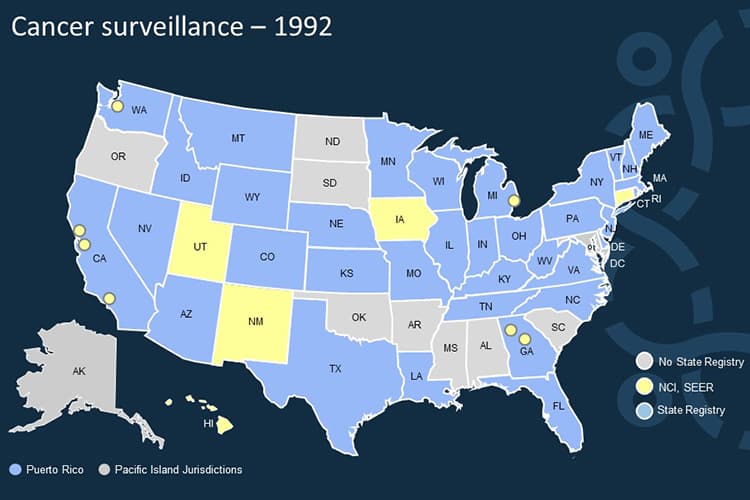
Before CDC’s National Program of Cancer Registries (NPCR) was established (1992), 10 states had no registry, and most states with registries lacked the resources and legislative support they needed to gather complete data. The United States needed a centralized national program to collect cancer data.
1992
U.S. Congress passed The Cancer Registries Amendment Act to establish CDC support for state and territory registries to collect basic data on cancer, such as incidence, stage, and initial treatment. This act created NPCR.
1994
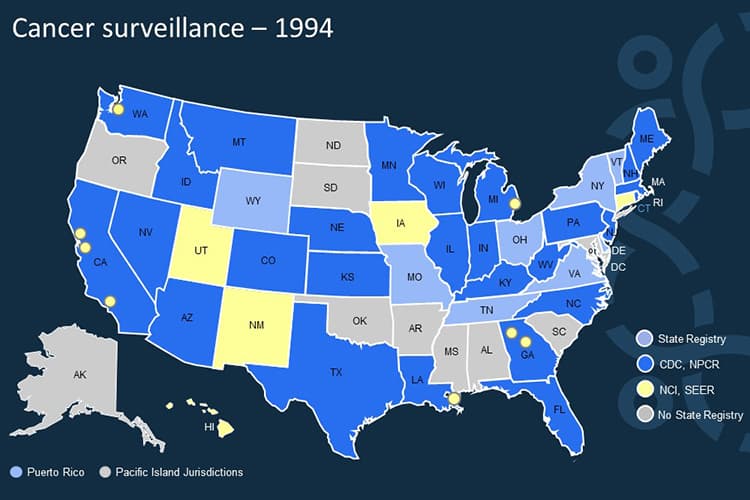
- By the end of 1994, 26 states received funding through NPCR.
- To facilitate data transmission and improve data quality, NPCR developed EDITS, software tools that standardize methods for identifying errors and inconsistencies in cancer registry data.

1996
NPCR released Abstract Plus. This software summarizes medical records into an electronic report of cancer diagnosis and treatment.
1999
- NPCR worked with the North American Association of Central Cancer Registries (NAACCR), central cancer registries, and a national laboratory to develop a national standard for reporting cancer pathology data to central cancer registries.
- NPCR released Prep Plus. This program incorporates NAACCR-formatted abstracts into a central cancer registry’s database.

2000
- NPCR released Central Registry System (CRS) Plus. It linked, consolidated, and maintained source records in a central cancer registry’s database. Together with Prep Plus, CRS Plus allowed registries to create records to submit to CDC each year. No information submitted to CDC identifies individual patients. The software is provided free of charge to NPCR registries.
- The NPCR-Cancer Surveillance System (NPCR-CSS) was established to receive, evaluate, and disseminate data from central cancer registries.
2001
- In January 2001, NPCR registries began reporting their cancer incidence data to CDC every year.
- Seven NPCR registries completed activities for the Patterns of Care: Breast, Colorectal, & Prostate Cancer Study and participated in the international CONCORD Study. Three NPCR registries received funding to conduct the Ovarian Cancer Treatment Patterns & Outcomes Study.
- All 50 states, the District of Columbia, U.S. Virgin Islands, and Puerto Rico had a central cancer registry.
2002
- In the fall of 2002, NPCR, the National Cancer Institute’s Surveillance, Epidemiology, and End Results (SEER) Program, and NAACCR jointly produce the first official federal cancer incidence statistics. The resulting report, U.S. Cancer Statistics: 1999 Incidence, provides state-specific and regional data for cancer cases diagnosed in 1999. The report included cancer statistics from 37 states, 6 metropolitan areas, and the District of Columbia. These areas contain about 78% of the United States population.
- Congress authorized the Benign Brain Tumor Cancer Registries Amendment Act. It requires cancer registries to collect data about non-cancerous brain tumors.

2003
The Indian Health Service (IHS) and CDC started a data linkage project to help registries describe the rates of cancer among American Indian and Alaska Native people more accurately. Data from 25 NPCR registries were linked with data from IHS patient administrative records to improve the classification of American Indian and Alaska Native people in the registries.
2004
NPCR started the Modeling Electronic Reporting Project (MERP) in collaboration with the Virginia Commonwealth University Health System, the Virginia Cancer Registry, and the SEER Program. MERP found the best ways to use the electronic medical record for cancer surveillance reporting.
2005
- NPCR established the Advancing E-cancer Reporting and Registry Operations (AERRO) project. The Electronic Pathology (ePath) project is part of AERRO. The ePath project helps registries implement electronic reporting of pathology reports and cancer biomarkers using NAACCR guidelines.
- NPCR developed Electronic Mapping, Reporting, and Coding (eMaRC) Plus to receive and process Health Level Seven (HL7) files from pathology laboratories.
2006
NPCR and CDC’s National Center for Health Statistics agreed to add data from the National Death Index to United States Cancer Statistics. This allows USCS to include data about survival.
2007
The U.S. Affiliated Pacific Islands established a central cancer registry.
2008
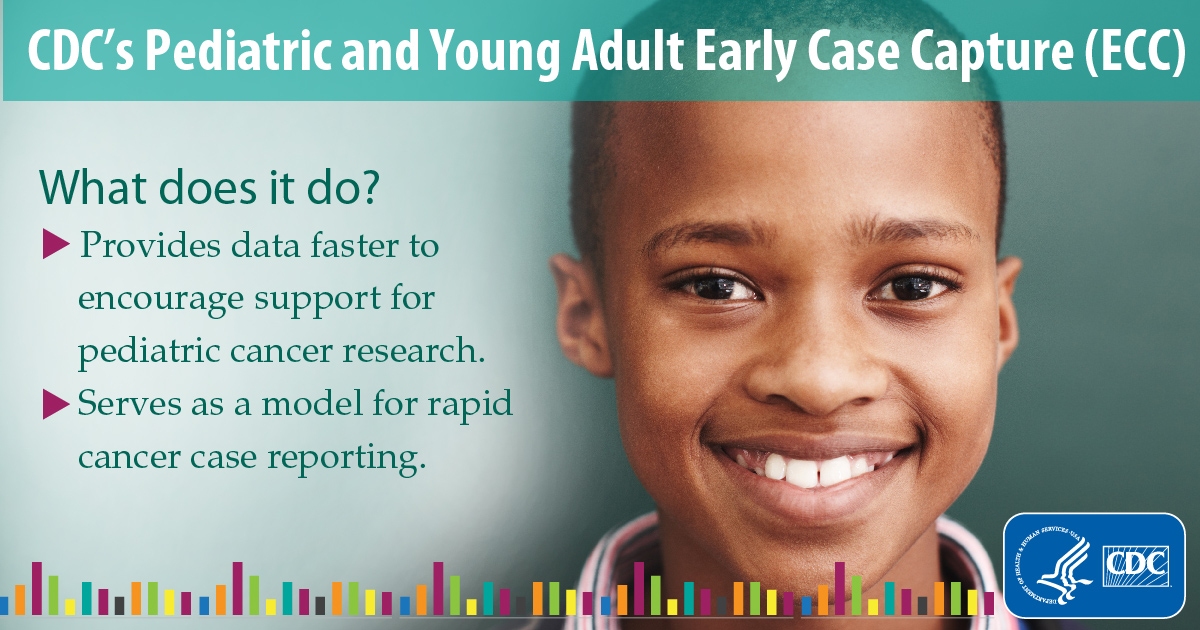
Congress authorized the Carolyn Pryce Walker Conquer Childhood Cancer Act. It established a national childhood cancer registry and provided support for electronic early case capture of childhood cancer cases.
2009
The American Recovery and Reinvestment Act was passed, increasing support for meaningful use of electronic health records. NPCR was instrumental in establishing electronic reporting to cancer registries as a public health objective.

2010
NPCR began collecting success stories from funded registries to describe their progress and value.
2016
NPCR and the Food and Drug Administration began working on a natural language processing (NLP) workbench. It provided access to NLP and machine learning tools needed to develop and share language models that map unstructured clinical text to standardized coded data.
2017
- CDC released the United States Cancer Statistics Data Visualizations tool. It displays the official federal statistics on cancer incidence and deaths.
- CDC released the first United States Cancer Statistics Public Use Database for cases diagnosed between 2001 and 2014.

2018
- Congress passed the Childhood Cancer Survivorship, Treatment, Access and Research (STAR) Act. It reauthorized the Carolyn Pryce Walker Conquer Childhood Cancer Act and allowed CDC to expand ways that laboratories can rapidly report cases of cancer among children, adolescents, and young adults into NPCR registries.
- NPCR launched the National Oncology rapid Ascertainment Hub (NOAH). NOAH supports analysis of laboratory reports and processes all data.
2021
NPCR started work on a data modernization initiative to develop a cloud-based computing platform specifically for cancer data. Laboratories and doctors successfully sent, and some central cancer registries received, data using the new platform.
2022
NPCR celebrated 30 years of helping central cancer registries collect high-quality data to measure progress, drive action, prevent cancers, and improve treatment for all people.
2026
For the first time, the USCS release included complete county-level data for new cancer cases reported in all 50 states, the District of Columbia, and Puerto Rico. Complete county-level data can improve understanding of how local, geographic, and environmental factors affect cancer prevention, treatment, survival, and survivorship care.
This page was last updated on this date. Updates may include minor edits, image changes, or other modifications to page content.
The information on this page was last reviewed by subject matter experts to ensure accuracy.