



At a glance
Some of the world's most dangerous disease outbreaks never make the headlines—and you may never hear about them at all. They don't close airports. They don't overwhelm hospitals. They don't disrupt daily life—or rattle the global economy. That's often because CDC and its global health security experts are on the frontlines—working with countries to quickly detect, respond to and contain outbreaks. This year, in recognition of World Field Epidemiology Day, this latest "Outbreaks You Never Heard About" campaign spotlights CDC-trained disease detectives and the crucial role they play in that work, strengthening the first line of defense against global health threats and helping protect American lives, livelihoods, and health security here at home.
Outbreaks You Never Heard About: CDC Experts on the Frontlines
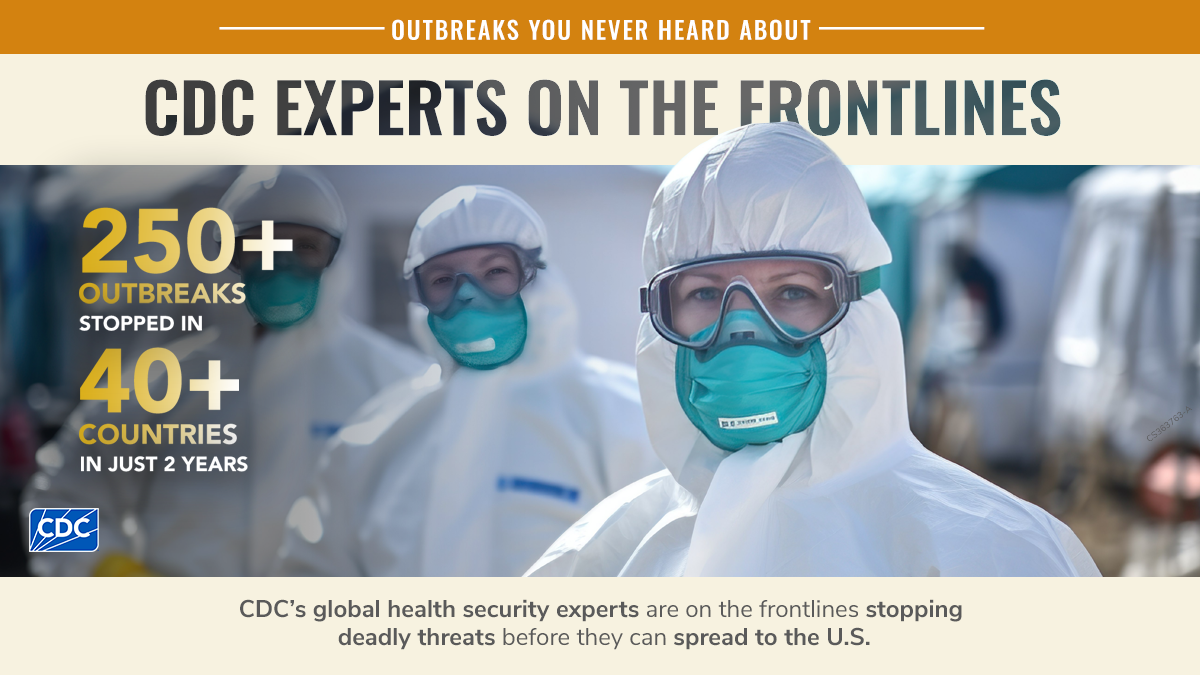
In today's world, where a health threat overseas can reach U.S. communities in just 36 hours, stopping outbreaks at their source is one of the most effective ways we protect Americans at home and abroad.
The current Ebola outbreak in the Democratic Republic of the Congo is a stark reminder of how serious these threats can become when they spread undetected and gain ground.
In the past two years alone, CDC's global health security experts helped contain more than 250 outbreaks across 40+ countries: from hemorrhagic fevers to Dengue, and from Marburg to Guillain-Barré syndrome.
These teams, based overseas and at CDC headquarters, form CDC's frontline global health security force. Together with partners across the U.S. government and around the globe, these world-class experts are on the frontlines keeping Americans safe. They not only lead emergency responses but also strengthen the systems that stop local disease outbreaks from becoming global crises, bolstering laboratories to quickly detect deadly pathogens, improving surveillance to track emerging threats, and training disease detectives to investigate and swiftly contain outbreaks.
CDC-Trained Disease Detectives on the Frontlines
At the center of many of these responses are CDC-trained field epidemiologists on the frontlines when dangerous outbreaks strike. These disease detectives are part of a global corps trained through CDC's landmark Field Epidemiology Training Program (FETP). More than 25,000 disease detectives have been trained through CDC-supported FETPs since 1980 in more than 100 countries around the world, where they are positioned as a first line of defense against deadly disease threats. They are often the first on the ground when outbreaks happen—identifying threats, investigating cases in real time, tracking how diseases spread, identifying those at risk, and helping stop outbreaks before they escalate.
Working at the very heart of outbreak response, these experts help stop dangerous outbreaks in their tracks and help keep them from ever reaching U.S. communities.
Outbreaks You Never Heard About: Stories from the Frontlines
Yet most of these outbreaks never make the news because they never escalate into global threats.
And that's the point.
These real-world examples with measurable results show how CDC's expertise helps move outbreaks from crisis to control before they reach U.S. communities, protecting Americans' health, safety, and livelihoods.
How CDC Helped Stop a Deadly Virus Before It Spread
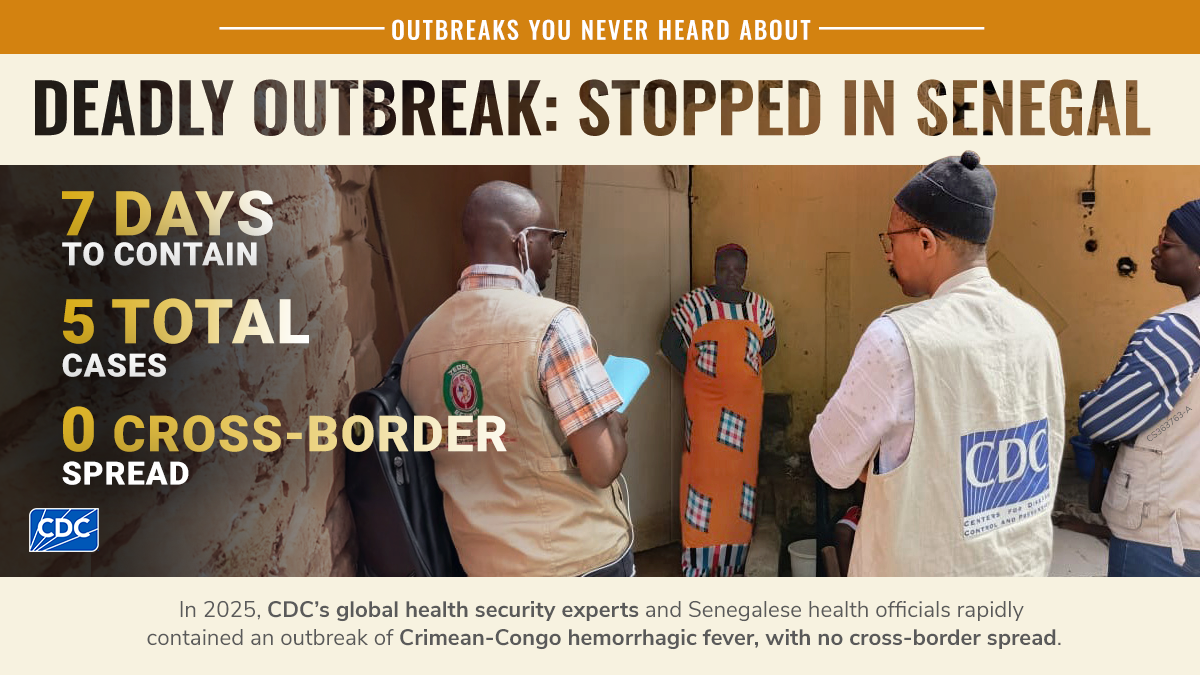
In January 2025, a deadly virus surfaced in Senegal's Kaffrine Region. Crimean-Congo hemorrhagic fever (CCHF)—a tick-borne disease that can also spread through infected animals and between humans—had sickened five people and killed one.
With a high fatality rate and multiple pathways for transmission, even a small cluster can quickly become something much larger. Stopping the virus meant understanding not only who had become sick, but where they had been, who they had come into contact with, and whether the disease was also circulating among animals.
CDC's Rapid Response
Within hours, CDC's global health experts and Senegalese health officials sprang into action, activating Senegal's Emergency Operations Center and launching a coordinated response. Among those responding were CDC-trained disease detectives, working alongside veterinarians, doctors, and anthropologists to trace how the virus was moving between people, animals, and affected communities.
Together, the teams identified and followed 51 potential contacts and tested more than 70 human and animal samples. They treated livestock, disinfected contaminated areas, and worked across human and animal health to identify possible exposures and interrupt transmission.
It was the kind of response CDC's Field Epidemiology Training Program is designed to make possible: trained disease detectives already on the ground, able to move quickly when a dangerous threat emerges, and work across disciplines to stop it.
Global Action. Local Impact.
Thanks to these efforts, the outbreak was contained in just one week—with only five cases and no wider spread.
The virus never moved beyond the affected area—protecting communities and livelihoods in Senegal and reducing the risk that a deadly outbreak could spread across borders cause significant human and economic harm and ultimately threaten Americans at home.
Stopping Lassa Fever in Its Tracks
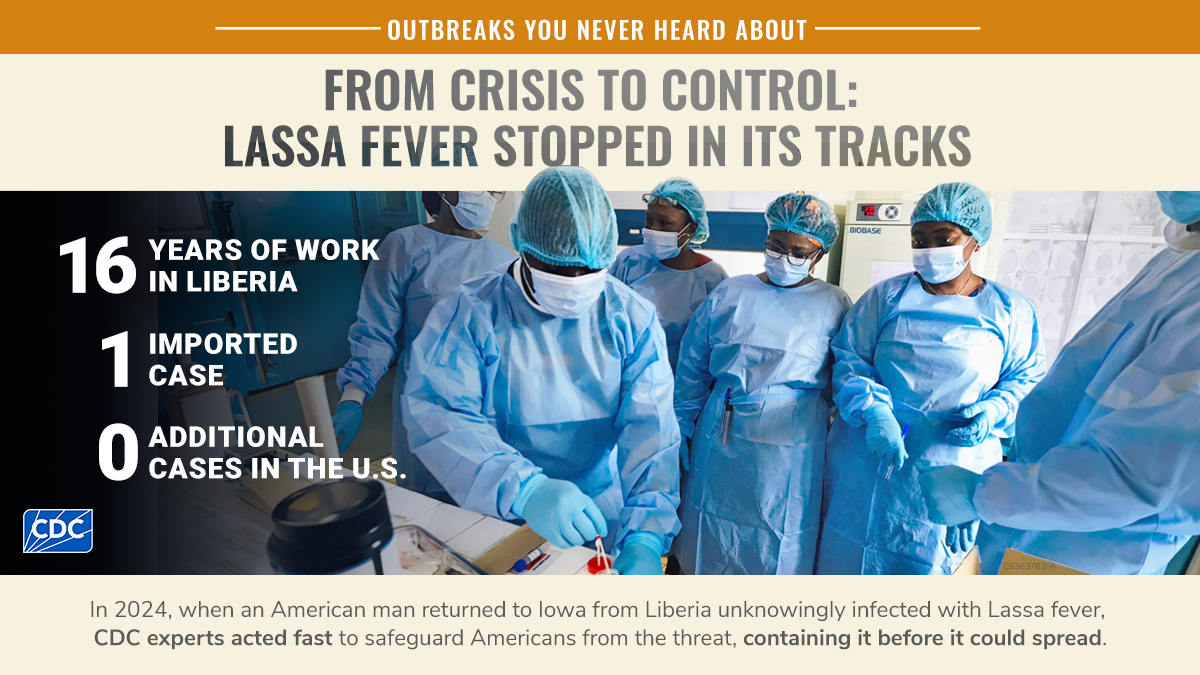
In October 2024, an American man returned to Iowa after a trip to Liberia. Unknowingly, he carried Lassa fever, a potentially deadly virus found in parts of West Africa. In the days after his arrival, he developed symptoms and visited three healthcare facilities, using two ambulances and emergency services along the way. Despite efforts to treat him, tragically, he died.
The case highlighted just how quickly a health threat overseas can become a threat here at home—and the critical role CDC's global health expertise plays in protecting communities around the world and in the United States.
CDC's Rapid Response
CDC's ability to respond in Iowa drew on 16 years of work in Liberia, where Lassa fever remains a persistent challenge. Working in partnership, CDC's global health teams and subject matter experts in Atlanta were able to provide Iowa health officials with the knowledge and guidance needed to diagnose the disease and prevent further spread.
Over the years, CDC teams in Liberia have assessed health facilities, trained local staff, and worked with Liberia's Ministry of Health and the National Public Health Institute of Liberia to strengthen disease detection and response. CDC experts have conducted active case searches, strengthened case tracking and genetic sequencing, and trained frontline health workers to recognize and respond to diseases like Lassa fever.
Those tools weren't just helping Liberia. When Lassa fever surfaced in Iowa, CDC's domestic and international teams mobilized quickly to support the state—providing laboratory confirmation, supporting the epidemiologic investigation and contact tracing, offering infection-prevention guidance, and helping protect healthcare workers who had been exposed.
Global Action. Local Impact.
Thanks to this rapid response, there was no additional spread in the United States beyond the single imported case.
By strengthening the systems and expertise needed to confront diseases like Lassa fever where they occur, CDC is better prepared when those same threats reach U.S. shores—helping protect communities overseas and Americans here at home.
Containing Ethiopia's First Marburg Outbreak Before It Spread
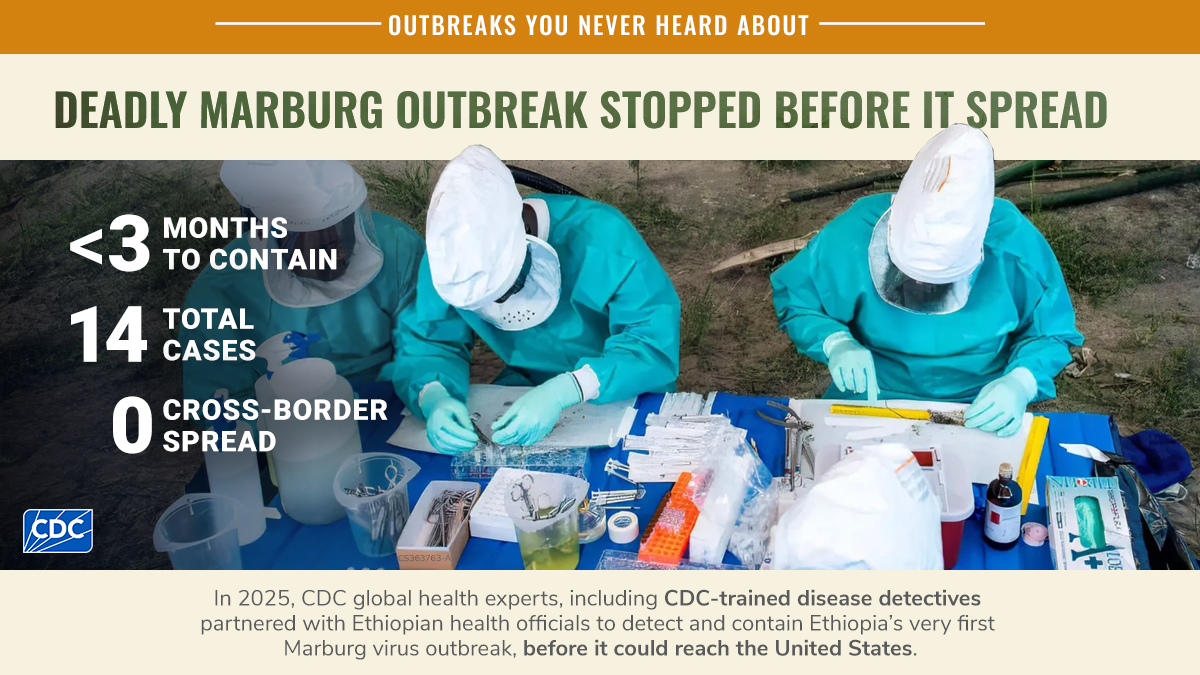
In November 2025, Ethiopia confronted a troubling historic episode: its first confirmed outbreak of Marburg virus. The deadly hemorrhagic fever quickly appeared across communities in the South Ethiopia and Sidama regions.
By early December, 14 cases had been confirmed and nine people had died. With no previous Marburg outbreak experience to draw from, the challenge was immediate: find those at risk, interrupt transmission, and keep the virus from reaching more communities—or crossing Ethiopia's borders.
CDC's Rapid Response
From the earliest days of the outbreak, CDC experts worked alongside Ethiopia's Ministry of Health. At the center of that effort were 17 CDC-trained Ethiopian field epidemiologists who deployed into affected communities to investigate cases, trace contacts, and track the virus in real time.
CDC experts and Ethiopian field epidemiologists strengthened laboratory testing and surveillance and reinforced infection prevention and control in health facilities. As new information came in, these teams used the data to guide the response—helping health officials see where the greatest risks remained and where action was needed most.
CDC experts also looked beyond the immediate outbreak. They helped strengthen border health measures including in Addis Ababa international airport, a major hub with multiple flights to the United States. They advised on bat ecology to reduce the risk of future transmission from animals to people, and also worked with neighboring countries to assess their readiness should the virus spread farther.
Global Action. Local Impact.
Within one month, transmission was interrupted, and six weeks later, the outbreak was fully contained—with just 14 confirmed cases.
Ultimately, the virus remained confined to two southern regions, never reached the capital, Addis Ababa, and never crossed an international border. As such, CDC's experts helped stop Ethiopia's first Marburg outbreak in its tracks before it could spread farther, threaten neighboring countries, or become a threat to the United States.
Stopping an Unexplained Neurological Illness Outbreak
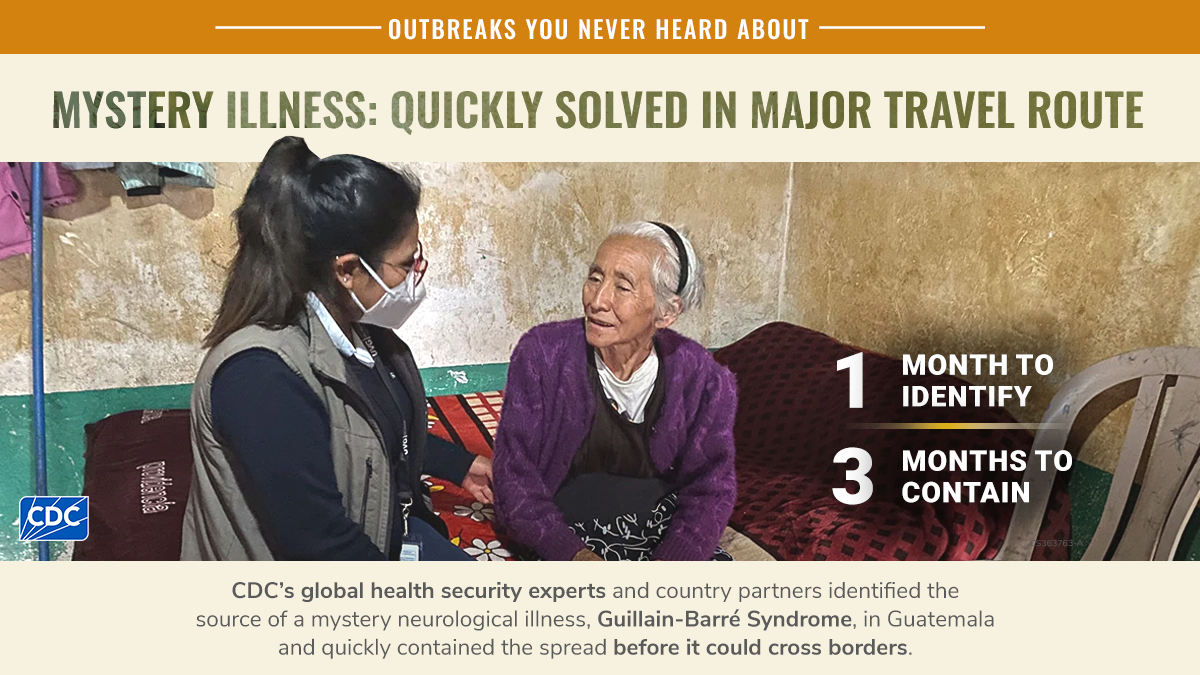
In late 2023, a cluster of severe neurological illness began appearing along Guatemala's Pan-American Highway. Patients were rapidly developing Guillain-Barré syndrome (GBS), a rare neurological disorder that can cause progressive muscle weakness and paralysis, potentially leading to respiratory failure.
But GBS can be triggered by a range of infections and other conditions. As case numbers grew, health officials faced difficult questions: what was making people sick, and was the source still putting others at risk? With cases appearing along one of Central America's major travel and trade corridors linking the region to the US, finding the answer quickly mattered well beyond the affected communities.
CDC's Rapid Response
CDC country office experts worked alongside Field Epidemiology Training Program graduates, Guatemala's Ministries of Health and Agriculture, and regional partners to find the source.
Teams searched door to door for additional cases, tested environmental samples, and compared those who became sick with those who did not to identify possible risk factors. Two CDC Epidemic Intelligence Service officers were deployed to strengthen the investigation and help determine what the cases had in common.
The laboratory offered another critical clue. Using advanced genomic sequencing to analyze patient and environmental samples, investigators detected Campylobacter, a common foodborne bacterium. Combined with epidemiologic findings linking illness to uncooked or poorly cooked foods, the evidence pointed to this foodborne bacterial contamination as the likely trigger.
Together, the field investigation and laboratory evidence gave health officials what they needed to understand the outbreak—and act.
Global Action. Local Impact.
Thanks to the rapid investigation, within 30 days, health officials had identified Campylobacter as the likely cause of the Guillain-Barré syndrome cluster, and within 90 days, the underlying Campylobacter outbreak was contained.
In all, 87 Guillain-Barré syndrome cases were identified, but the cluster remained localized, with no linked cases identified across borders. By identifying the likely trigger and quickly containing the Campylobacter outbreak, CDC and country partners protected communities while reducing the risk that infections along a major travel and trade corridor could spread farther, including toward the United States.
Finding Deadly Diseases Hidden in Plain Sight
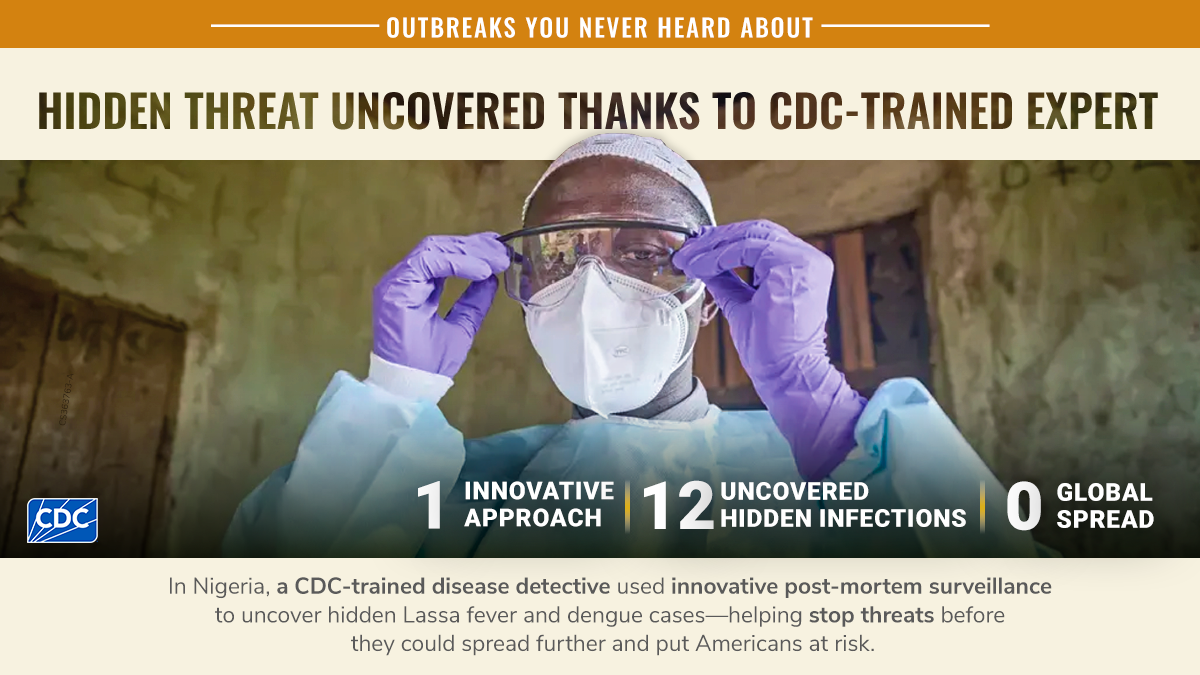
In northwest Nigeria, people were dying with fever, but the disease that killed them was not always known. Lassa fever and dengue can look like other common illnesses in their early stages, allowing dangerous infections to go undetected.
For health officials, those missed diagnoses created a troubling blind spot. When someone died without a clear diagnosis, an important warning could disappear from the surveillance system even while the disease continued circulating in the community.
In Sokoto State, a CDC-trained disease detective recognized the gap.
CDC's Rapid Response
Instead of waiting for the next diagnosed case to reveal what was circulating, the disease detective helped establish a new post-mortem surveillance system at two referral hospitals.
Teams interviewed family members and caregivers, reviewed medical records, andintroduced post-mortem testing for Lassa fever, dengue, and malariausing blood samples from people who had died following a fever.
The approach gave health officials another way to look beneath the surface to identify dangerous infections that routine surveillance might never see, and better understand what diseases were circulating in the community.
Global Action. Local Impact.
The results revealed what traditional surveillance had missed. Using this novel approach, investigators uncovered 11 Lassa fever infections and one dengue infection that had previously gone unrecognized.
By bringing hidden threats into view, a CDC-trained disease detective gave local health officials the critical information they needed to identify dangerous diseases and guide public health action, ultimately reducing the risk that an undetected threat could eventually reach the United States.
Why It Matters: Outbreaks You Never Heard About—Because CDC Was There
Behind many of the outbreaks you never hear about are CDC global health experts and CDC-trained disease detectives on the frontlines containing dangerous health threats around the world. They are often among the first on the ground when outbreaks strike: finding cases, tracing contacts, tracking how diseases spread, identifying hidden threats, and helping stop them before they can escalate.
That impact reaches across the globe. Since 1980, CDC's landmark Field Epidemiology Training Program has trained more than 25,000 disease detectives in more than 100 countries, building a global corps equipped to detect threats early, investigate outbreaks in real time, and act quickly when every hour counts.
That reach translates into real-world impact. Marburg was stopped before it crossed Ethiopia's borders. Crimean-Congo hemorrhagic fever was contained in Senegal in just one week. Disease detectives in Nigeria uncovered deadly infections that had been circulating undetected. And when Lassa fever reached Iowa, the virus was stopped in its tracks—with no additional spread. Through global health security, CDC is helping countries detect outbreaks earlier, respond faster, and contain dangerous diseases at their source—before they can threaten U.S. communities, disrupt travel and trade, or put American lives and livelihoods at risk.
Stopping outbreaks before they spread isn't just smart public health. It's national security. It's economic security. And it's what CDC's global health experts and CDC-trained disease detectives do every day to help keep Americans safe.
This page was last updated on this date. Updates may include minor edits, image changes, or other modifications to page content.
The information on this page was last reviewed by subject matter experts to ensure accuracy.