



Key points
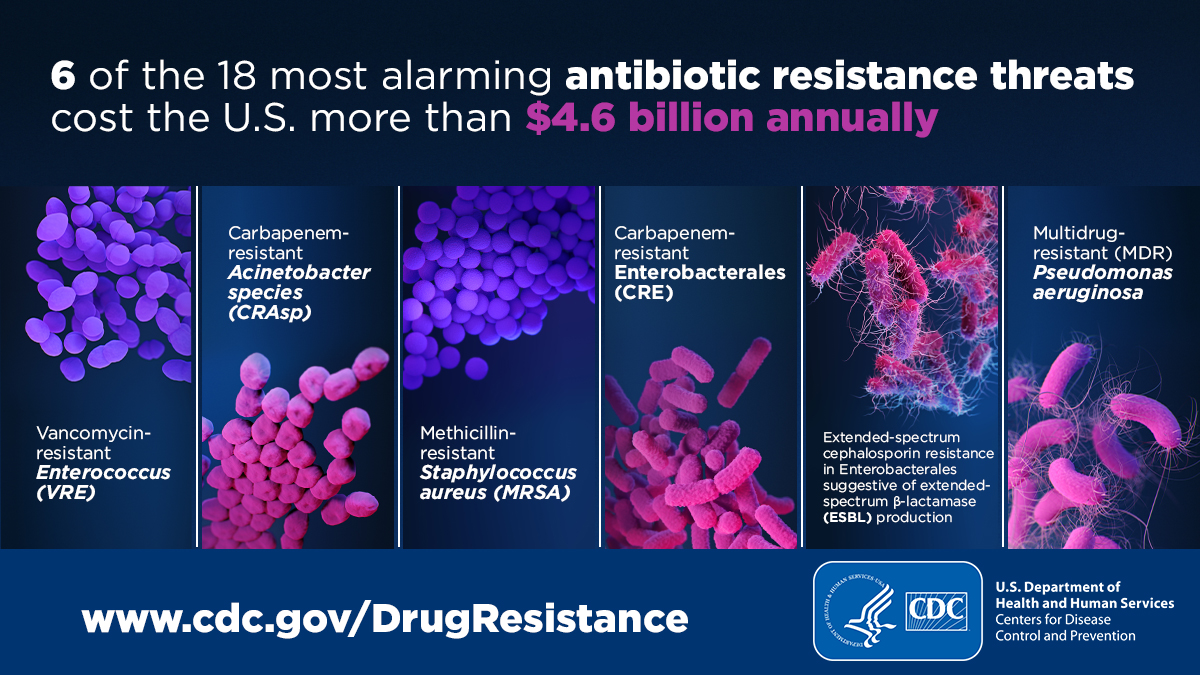
- CDC worked with experts at the University of Utah School of Medicine to estimate that treating six antimicrobial resistance (AR) threats contribute to more than $4.6 billion in healthcare costs annually.
- Partnerships like this help CDC gain better understanding of the impact of AR in health care, help clinicians target infection control practices and support healthcare decision makers to make informed choices that improve patient safety.
CDC partners with experts to estimate healthcare costs of antimicrobial-resistant infections
Posted: April 2021
Many of the germs that cause antimicrobial-resistant infections are frequently found in healthcare settings, resulting in increased risks to patient safety and a burden on the healthcare system as these infections often require substantial healthcare resources to treat.
To better understand the financial burden these infections place on health care, CDC teamed up with experts at the University of Utah School of Medicine and released estimates that treating six of the most alarming antimicrobial resistance threats identified by CDC contribute to more than $4.6 billion in healthcare costs annually.
This is one of the largest studies on healthcare costs associated with treating antimicrobial-resistant infections to date, encompassing the total costs of medical personnel, equipment and the space necessary to treat these patients. The estimates do not include other downstream healthcare costs that occur after the first hospitalization or economic impacts to the patients, indicating that the overall costs could be even higher.
Leveraging the existing partnership through CDC's Prevention Epicenters Program—and resources from the Department of Veterans Affairs (VA) Medical Center and the VA Health Services Research and Development Service—the researchers used methods designed to overcome limitations of previous studies to generate more accurate healthcare costs from AR.
The large size of the VA datasets and the detailed information they contained allowed the researchers to isolate cost information specifically attributable to the antimicrobial-resistant germs of interest while accounting for the location of the infection in the body and timing of infection while hospitalized. They then multiplied the pathogen-specific cost data by national infection case counts, previously published in the 2019 AR Threats Report and Multidrug-Resistant Bacterial Infections in U.S. Hospitalized Patients, 2012-2017 to find the estimated total healthcare costs to treat these infections.
Cost estimates like these can help the U.S. Government, healthcare facilities and other organizations better understand the value of investments to prevent infections and slow the spread of germs. Estimates like these also underscore the healthcare costs associated with these infections and the economic benefits of preventing infections before they start.
CDC has proven that dedicated prevention and infection control efforts are working and are a best buy for public health. Between 2013-2019, investments in these areas have reduced deaths from antimicrobial resistance by 18% overall and nearly 30% in hospitals alone.
The University of Utah School of Medicine has partnered with CDC through its Prevention Epicenters Program and Modeling Infectious Diseases in Healthcare (MInD)—innovative research programs with academic investigators to conduct infection control and prevention research—since 2015, collaborating with the VA and its medical centers to explore and implement new prevention strategies and reduce antimicrobial resistance transmission (spread) in health care.
Partnerships like this one help CDC gain a better understanding of the impact of antimicrobial resistance in health care, help clinicians target infection control practices and support healthcare decision makers to make informed choices that improve patient safety.
Learn more about how CDC is collaborating on research with partners, including the Prevention Epicenters Program and MInD, to help drive action to combat antimicrobial resistance and save lives.
This page was last updated on this date. Updates may include minor edits, image changes, or other modifications to page content.
The information on this page was last reviewed by subject matter experts to ensure accuracy.